What is the Impact of the Iran War on Domestic Terror Threats in the UK?
What is the Impact of the Iran War on Domestic Terror Threats in the UK?
The Iran war, which started on 28th February 2026, has materially elevated the risk of domestic terrorism in the United Kingdom (UK). Over 20 Iranian plots have been uncovered in the UK in the past 12 months, the UK terror threat level was placed under immediate review following the initial strikes, and a declared terrorist incident in Golders Green in April 2026 was claimed by an Iran-linked proxy group. Analysis of three comparable conflicts - Afghanistan, Iraq, and Syria - indicates the risk of domestic radicalisation, proxy attacks, and lone-actor violence will increase in the months ahead.
Introduction
The UK’s security environment has been shaped by global and domestic terror threats in recent years, demonstrated by the 2017 Manchester Arena bombing, which led to the development of Martyn’s Law, and the 2025 Manchester synagogue attack. The growth of terrorism against Western countries, including the UK, is evidenced by the fact that where terrorism has substantially decreased worldwide since 2025, it has substantially increased in Western countries (1). Threat levels in the UK have remained at ‘substantial’ or above since 2019 (2). Since March 2017, counter-terrorism police in conjunction with MI5 have disrupted at least 43 late-stage attack plots, 75% of which were part of Islamist extremism (3). This is further complicated by the fact that threat actors are mostly lone individuals radicalised and indoctrinated online (3).
Iran has been an important player in terror threats to the UK. MI5 has responded to at least twenty Iran-backed plots with potentially lethal threats to UK residents since January 2022 (3), and groups such as al-Qaeda (AQ), with which Iran holds ties, actively exploit conflict in the Middle East to call for violent action, seen in Yemen and Gaza (4). As a result, serious concerns have been raised over whether the US and Israel war with Iran and its proxies - hereafter the Iran war - launched on 28th February 2026, could escalate the risk of terrorism in the West and the UK (1).
The potential impact of hostilities with Iran on domestic terror threats has already been made clear. In the past 12 months, over 20 Iranian plots including kidnaps and attempted assassinations have been uncovered (5), compared with 10 in 2023, and the UK terror threat level was immediately put under review following the initial strikes on Iran (6). The stabbing of two Jewish men in Golders Green in April 2026, an attack declared a terrorist incident by the police, demonstrates an already-growing risk of terrorism – whilst inquiries are still underway and correlation has not been confirmed, an Iran-linked terror group known as Harakat Ashab al-Yamin al-Islamia (HAYI) has claimed responsibility for the attack, illustrating the threat of potential Iranian proxies in the UK (7).
Patterns during previous conflicts can help further elucidate the impact of the Iran war on upcoming domestic terror threats. This article will analyse conflict in Afghanistan, Iraq and Syria, assessing similarities with conflict in Iran, to demonstrate how the Iran war may increase the threat of terrorism in the UK.
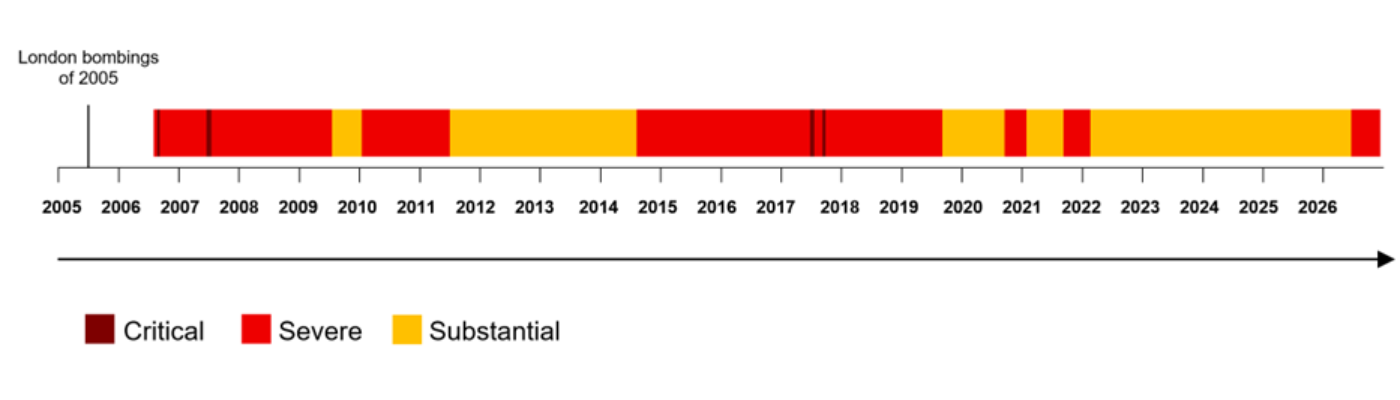
Figure 1: Approximate representation of UK threat levels throughout the 21st century (2).
Afghanistan Conflict (2001 and 2021)
The Taliban became prominent in the 1990s, gaining control of the Afghan government in 1996 (8). The US-led invasion in 2001 drove the Taliban out of power for the next two decades, however the Taliban maintained a strong influence (1). During this time, the group focused on recapturing border regions, launching large-scale incursions from Pakistan, profiting from illicit smuggling as well as building a weapons supply (1). This facilitated the Taliban’s return to power in 2021, and since then, they have served as a sanctuary for extremist groups such as the Tehrik-i-Taliban Pakistan and Islamic State Khorasan Province (ISKP) (1).
It is widely argued that the US’ 2001 invasion, motivated by a desire to reduce Taliban influence, facilitated the 2021 return to power (9), demonstrating the risk of targeting state-sponsored terrorism. Tensions between the US and Iran are similarly motivated in part by fears over state-sponsored terrorism, with the US listing Iran as a “state sponsor of terrorism” since 1984 (10). State-sponsored terrorism increases capacity by providing extremist organisations with official support, demonstrating why targeting terror-enabled governments has been a key strategy in diminishing the power of extremist groups. However, as seen in Afghanistan, this is insufficient without a commitment to stabilisation missions (11). On the contrary, it can provide an opportunity for extremist groups to find new sources of funding, allies and supporters, facilitating a return to power. Experts argue that even if the US and Israel successfully topple state-sanctioned terrorism in Iran, a resurgent Islamic Revolutionary Guard Corps (IRGC), considered a terrorist organisation by major actors including the European Union and the US, will likely return (11). The US has not shown a desire to administer a post-conflict Iran, and the IRGC has the ability to create an organised insurgency or embed itself within the population through fragmented armed cells, increasing the likelihood of radicalisation and terrorist activity (11). Iran’s support for proxies such as Hezbollah, the Houthis and Hamas (12) further strengthens its ability to engage in terror-motivated activity without state sponsorship, providing them with the training, weaponry and funds to conduct attacks (12). Iran-linked sleeper cells, which experts have warned may exist in Europe, could also act as proxies to conduct strikes against the West (13).
It is further important to recognise that a key component allowing the Taliban’s return to power was the border with Pakistan, which supported regrouping and the launching of large-scale attacks from 2001 to 2021 (1). Similarly, Iran’s borders with Afghanistan and Pakistan could become havens for extremist groups, allowing infiltration and attacks to intensify (11). The relationship between the Iranian government and the Taliban is growing despite religious tensions. In 2025, an Iranian delegation visited Afghanistan for high-level talks with the Taliban (8), and Iran provided support to the Taliban throughout 2001-2021 (14). Cooperation between Iran and Afghanistan and use of border regions for extremist activities, such as terror funding through arms and drug trafficking, could facilitate the strengthening of Iranian terror networks, despite attempts to disrupt them.
Ultimately, the case of Afghanistan demonstrates that targeting terror-enabled governments does not always weaken the threat of terrorism, and can increase terrorist violence by providing extremist groups with further support, discourse and the opportunity to become embedded in civil society. It may also improve cooperation with neighbouring terror networks, as state-sanctioned terror groups begin activities along borders. This is particularly the case for countries such as Iran which support terror-motivated proxies and potential sleeper cells. In the case of a destabilisation of Iranian state-sanctioned terrorism, it is likely that the months following would see an increased capacity of Iranian terror groups to operate transnationally, improving their ability to coordinate attacks within the UK.
Iraq Conflict (2003-2011)
In March 2003, the UK joined a US-led coalition in the invasion of Iraq, which overthrew Saddam Hussein’s dictatorship and divided the country between Sunni, Shia and Kurd ethnoreligious lines. The primary goal was to disarm Iraq of Weapons of Mass Destruction (WMD), which it was believed to possess (15). Likewise, the Iran war has been in part motivated by fears over Iran’s nuclear programme (16). Military involvement in Iraq was contentious, particularly when it later became apparent that Iraq had largely abandoned WMD programmes (15). Similarly, 49-50% of UK responders opposed allowing the US to launch strikes from RAF bases even if targets are restricted to missile sites, demonstrating disagreement with the UK government’s position on strikes in Iran (17). Decisions following the invasion of Iraq, such as dismantling Iraq’s military institutions and fuelling sectarian polarisation, allowed groups such as AQ and IS to exploit narratives and discourse for follower gain and grow transnationally (18). When it became apparent that Iraq’s WMD capacity was not as extensive as initially thought, beliefs spread that the war was illegitimate (18), and extremist groups were able to exploit these grievances to increase recruitment.
The exploitation of grievances was not concentrated regionally and spread to Western countries such as the UK. Former head of MI5 Baroness Manningham-Buller has stated that the war substantially increased the terror threat to the UK through youth radicalisation, saying that some British citizens saw the UK’s involvement in Iraq as being an attack on Islam (19). The killing of Ali Khamenei in February 2026 has already created, for some, a sense of martyrdom (20). Former Met officer Neil Basu has also stated that “a driver of the [7th July 2005] attacks were foreign policy and Iraq [which] radicalised and made extremists of people who might not have been radicalised or extreme” (21). The 7/7 terrorist incident saw suicide bombers attacking three underground trains and a bus in London, killing 52 people and injuring over 750. It was later revealed that the criminals involved were AQ-backed British-born terrorists (21).
Evidently, the invasion of Iraq enabled conditions for terrorist organisations to expand transnationally and exploit sentiment over the war in the UK. This is likely to have been a serious motivator behind domestic radicalisation, increasing the threat of terror-motivated violence. In the case of the Iran war, some have argued that a similar trajectory may be seen. Research groups have already argued that the UK is a flashpoint for Iranian influence efforts (22), and it is believed that British Muslim youth are particularly vulnerable to Islamist radicalisation following international events (23). This is especially the case due to increased access to the internet which hosts ample propaganda material (23). Protests in 2026 have made evident that grievances over strikes on Iran are already present (24). A London Al Quds Day march was banned to prevent “serious public disorder” in March 2026, with fears that the march organisers were “supportive of the Iranian regime” (25). The historical precedent for increased terrorist radicalisation through the exploitation of grievances in the UK after attempts to disrupt WMD programmes, often seen as illegitimate, accompanied by the already growing domestic grievances over strikes on Iran, indicate a strong likelihood that the threat of radicalisation, anti-West sentiment and terrorist violence will increase in the upcoming months.
Syrian Conflict (2011-2024)
In 2011, pro-democracy protests in Syria were met with heavy force by Bashar al-Assad’s government. Unrest escalated into all-out conflict, with then US-president Obama providing military support to groups which opposed Assad’s rule and intervening militarily to combat IS in 2014, with the help of allies such as the UK (26). The US-led coalition was especially motivated after a series of coordinated IS attacks in Europe in 2015. Whilst President Trump largely withdrew from the conflict in his first presidential term, the US maintains a presence in Syria where it continues military operations against IS and AQ affiliates (27). Regime change was a key aspect of the conflict in Syria, and when Assad was ousted in 2024, the US eased sanctions (27) and engaged in diplomatic talks (28) with new president Ahmed al-Sharaa. In the Iran war, regime change has similarly been an important factor, with the killing of Khamenei disrupting Iran’s status quo of the past several decades. Despite the implementation of a new Supreme Leader in March 2026, political instability persists due to accusations of political interference and controversy over his selection (29).
Whilst Syria has shifted away from Assad’s regime, the fragile transition, continued clashes in the northeast and rising sectarian tensions in the southwest have created a power vacuum, which IS has rapidly exploited (27). IS activity along the border has significantly increased, with attacks going up to 294 in 2024 from 121 in 2023 (11). In March 2026, it was confirmed that the fragile security architecture around the Al-Hol detention camp collapsed due to a coordinated prison break, leading to the release of over 20,000 prisoners, most of which were affiliated to IS fighters and families (11). This represents a case where the destabilisation of state structures due to regime change allowed for terrorist organisations to exploit weak security infrastructure such as detention camps, gaining supporters and expanding operations (11).
Experts have already begun demonstrating the instability prompted by the killing of Khamenei and push for regime change in Iran, which provides opportunities for groups to consolidate influence by exploiting a potential power vacuum (30). ISKP has historically attacked Iran, and may purposefully try to worsen conflict to establish a stronger territorial presence, strengthening its foreign fighter networks and proxies, and posing a direct threat to the UK. AQ has been allowed to facilitate financial transactions and the movement of fighters across Iran for the sake of disrupting Western interests, providing the organisation with a foothold in Iran (30). However, religious hostilities between the Iranian government and AQ mean that regime change could push AQ to capitalise on political instability and establish a base of operations from within the country to coordinate international terrorist attacks (30).
The case of Syria demonstrates that unstable regime change can increase the threat of terrorist violence through the creation of a power vacuum exploited by terrorist organisations. The presence of numerous groups in Iran means that organisations such as AQ and IS could exploit the ongoing political instability to establish stronger footholds and enable recruitment, facilitating terrorist activities regionally and internationally, and increasing the threat of terrorist violence in the UK.
Implications
| Similarity to the Iran War | Impact on Domestic Terror Threat | |
|---|---|---|
| Afghanistan Conflict | Targeting state-sponsored terrorism | Increased presence in civil society and cooperation with neighbouring terror groups |
| Iraq Conflict | Attempting to disarm WMD | Increased radicalisation by exploiting war grievances |
| Syria Conflict | Pushing for regime change | Creation of a power vacuum which allows organised and lone-actor terrorism to expand |
Figure 2: Similarities of the Iran war with the Afghanistan, Iraq and Syria conflicts.
Previous conflicts demonstrate that the Iran war may worsen domestic terror threats by increasing radicalisation and anti-West sentiment, pushing terrorist groups into civil societies and cooperation with neighbouring groups, and leaving a power vacuum which terrorist organisations could exploit, particularly after a lack of stabilisation mission. This has serious physical, digital and behavioural implications.
The increase in the likelihood of a terror attack creates a need for specialised protective intelligence services. This is particularly the case for high-profile individuals, organisations and events which are publicly exposed and may be specifically targeted for political or ideological reasons, such as politicians, religious leaders, celebrities and prominent corporate figures. Specific buildings and assets may also be targeted, as seen during the 2025 Manchester synagogue attack, creating a need for house surveillance and static protection operatives. Individuals of certain demographics or living in certain areas may also be targeted, as evidenced during the 2026 Golders Green stabbing. This could be made worse by organised or lone actors exposing private addresses online, providing information needed to conduct an attack against a specific person or event. Growing online radicalisation demonstrates the importance of effective digital protection, particularly in the UK, which is specifically targeted through influence networks by extremist actors. An increase in terrorism could also deteriorate the sociopolitical stability of the UK, which in turn increases the risk of violent unrest. Social and ethnic grievances, worsened in the aftermath of terrorist targeting, may prompt hostilities between different communities, exacerbating division and encouraging terror or ideologically driven activities such as political and hate-motivated violence.
Risk management consultancies and private security services support individuals’, organisations’, and events’ security and resilience in the face of growing domestic terrorism. A host of services including tailored protective intelligence gathering and threat identification practices, pre-vetted close protection teams and a 24/7 response and overwatch structure combine together in a comprehensive security management framework to enable targeted risk-based decision making, protect clients and shield reputation.
Frequently Asked Questions
What is the current UK terror threat level?
The UK’s terror threat level is currently set at ‘severe’, meaning an attack is highly likely. Threat levels have remained at ‘substantial’ or above since 2019. Following the start of the Iran war in February 2026, the threat level was placed under immediate review. Individuals and organisations should monitor MI5 guidance for the latest position.
| UK THREAT LEVEL SYSTEM | |
|---|---|
| CRITICAL | AN ATTACK IS EXPECTED IMMINENTLY |
| SEVERE | AN ATTACK IS HIGHLY LIKELY (Current UK National Threat Level) |
| SUBSTANTIAL | AN ATTACK IS A STRONG POSSIBILITY |
| MODERATE | AN ATTACK IS POSSIBLE, BUT NOT LIKELY |
| LOW | AN ATTACK IS UNLIKELY |
Figure 3: The UK’s threat level system (2).
How does the Iran war affect domestic terrorism in the UK?
Analysis of comparable conflicts indicates three mechanisms through which the Iran war may increase domestic terrorism: increased presence of extremist groups in civil society and cooperation with neighbouring terror groups; increased radicalisation by exploiting grievances; creation of a power vacuum which allows organised and lone-actor terrorism to expand.
What is state-sponsored terrorism?
State-sponsored terrorism is when a government provides support in various forms to extremist organisations, increasing their capacity and influence. Iran has been designated a state sponsor of terrorism by the US since 1984, with proxies including Hezbollah, the Houthis, and Hamas.
What is the IRGC?
The Islamic Revolutionary Guard Corps (IRGC) is a military organisation part of the Iranian Armed Forces, designated as a terrorist organisation by major actors including the European Union and the US. Experts have warned that a resurgent IRGC could reconstitute as an organised insurgency or fragmented armed cells embedded in the population, even if Iranian state-sanctioned terrorism is disrupted.
What protective measures should organisations take in the current threat environment?
Organisations should assess their threat profile and consider tailored intelligence gathering, close protection, and a 24/7 security management framework proportionate to their exposure. Peregrine Risk Management provides protective intelligence, close protection, and security risk consultancy services. Contact the team at enquiries@peregrine-rm.com or call +44 (0) 1568 607 00
Bibliography
1. Institute for Economics and Peace. Global Terrorism Index 2026: Measuring the impact of terrorism. Sydney: Institute for Economics and Peace; 2026. Available from: https://www.visionofhumanity.org/wp-content/uploads/2026/03/Global-Terrorism-Index-2026-Report.pdf
2. Security Service MI5. Terrorism threat levels. 2024. Available from: https://www.mi5.gov.uk/threats-and-advice/terrorism-threat-levels
3. Security Service MI5. Director General Ken McCallum gives latest threat update. 2024. Available from: https://www.mi5.gov.uk/director-general-ken-mccallum-gives-latest-threat-update
4. Security Service MI5. Director General Sir Ken McCallum gives threat update. 2025. Available from: https://www.mi5.gov.uk/director-general-sir-ken-mccallum-gives-threat-update
5. France A. Iran war has raised risk of attack in Britain, top terror chief warns. The Standard. 2026 Mar 26. Available from: https://www.standard.co.uk/news/crime/met-police-iran-war-risk-attack-britain-terror-golders-green-arrested-b1276527.html
6. Sky News. UK terror threat 'absolutely' under review after Iran strikes, defence secretary says. 2026 Mar 1. Available from: https://news.sky.com/story/uk-terror-threat-absolutely-under-review-after-iran-strikes-defence-secretary-says-13513847
7. Sabbagh D. Golders Green attack claim highlights rise of shadowy Iran-linked group. The Guardian. 2026 Apr 29. Available from: https://www.theguardian.com/uk-news/2026/apr/29/golders-green-attack-claim-highlights-rise-of-shadowy-iran-linked-group
8. Murad M. Are Taliban-Iran Relations Moving on a Positive Trajectory? The Diplomat. 2025 Sep 22. Available from: https://thediplomat.com/2025/09/are-taliban-iran-relations-moving-on-a-positive-trajectory/
9. Weigand F. Why Did the Taliban Win (Again) in Afghanistan? LSE Public Policy Review. 2022 Mar 9; 2(3): 1-10. Available from: https://ppr.lse.ac.uk/articles/10.31389/lseppr.54
10. Fields J. US and Iran: A brief history of how decades of mistrust and bad blood led to open warfare. The Conversation. 2026 Apr 4. Available from: https://theconversation.com/us-and-iran-a-brief-history-of-how-decades-of-mistrust-and-bad-blood-led-to-open-warfare-279712
11. Institute for Economics and Peace. The Iran War and the Global Terrorism Threat. Sydney: Institute for Economics and Peace; 2026. Available from: https://www.visionofhumanity.org/wp-content/uploads/2026/03/The-Iran-War-and-The-Global-Terrorism-Threat.pdf
12. Robinson K, Merrow W. Iran's Regional Armed Network. Council on Foreign Relations. 2024 Apr 15. Available from: https://www.cfr.org/articles/irans-regional-armed-network
13. Riffler Z. Germany warned of Iranian sleeper cells after Tehran's fatwa on West. Euro News. 2026 Mar 3. Available from: https://www.euronews.com/2026/03/03/germany-warned-of-iranian-sleeper-cells-after-tehrans-fatwa-on-west
14. Akbarzadeh S, Ibrahimi N. The Taliban: a new proxy for Iran in Afghanistan? Third World Quarterly. 2019 May 02; 41(5): 764-782. Available from: https://doi.org/10.1080/01436597.2019.1702460
15. Gaskarth J. How the Iraq War led to a legacy of public mistrust in intelligence. The British Academy. 2020 Feb 24. Available from: https://www.thebritishacademy.ac.uk/blog/how-iraq-war-led-legacy-public-mistrust-intelligence/
16. BBC News. Why did US and Israel attack Iran and how long could the war last? 2026 Apr 23. Available from: https://www.bbc.co.uk/news/articles/cx2dyz6p3weo
17. YouGov. UK public opinion on the US-Iran conflict. 2026. Available from: https://yougov.com/en-gb/articles/54243-uk-public-opinion-on-the-us-iran-conflict
18. Sadaghashvili T. The U.S.-Iraq War's Legacy in Global Terrorism and the Taliban's Return to Power. ESJ. 2025 Oct 31; 21(29): 161-170. Available from: https://eujournal.org/index.php/esj/article/view/20249
19. BBC News. Iraq inquiry: Ex-MI5 boss says war raised terror threat. 2010 Jul 20. Available from: https://www.bbc.co.uk/news/uk-politics-10693001
20. The Economist. Why Ali Khamenei may have welcomed the nature of his death. 2026 Mar 3. Available from: https://www.economist.com/middle-east-and-africa/2026/03/03/why-ali-khamenei-may-have-welcomed-the-nature-of-his-death
21. Dodd V. Iraq war 'made extremists of people': ex-police terrorism chief looks back at 7/7. The Guardian. 2025 Jul 6. Available from: https://www.theguardian.com/uk-news/2025/jul/06/iraq-war-made-extremists-of-people-ex-police-terrorism-chief-looks-back-at-77
22. NUFDI Policy Team. The Islamic Republic of Iran's Influence Network Inside the United Kingdom. Maryland: NUFDI; 2025. Available from: https://nufdiran.org/reports/the-islamic-republics-influence-network-in-the-united-kingdom/
23. Abbas T. Conceptualising the waves of Islamist radicalisation in the UK. Journal of Contemporary European Studies. 2023 Apr 20; 32(3): 705-718. Available from: https://doi.org/10.1080/14782804.2023.2204421
24. PA Media. Thousands march on US embassy in London calling for end of strikes in Iran. The Guardian. 2026 Mar 7. Available from: https://www.theguardian.com/world/2026/mar/07/thousands-march-on-us-embassy-in-london-calling-for-end-of-strikes-in-iran
25. Jackson P, Smith A. March organised by Iran-linked group banned after police request. BBC News. 2026 Mar 11. Available from: https://www.bbc.co.uk/news/articles/cm28gmlvedro
26. Moench M. The global players in Syria before and after Assad. BBC News. 2024 Dec 10. Available from: https://www.bbc.co.uk/news/articles/cd75e8gdy9jo
27. Centre for Preventive Action. Conflict in Syria. Global Conflict Tracker. 2026 Feb 18. Available from: https://www.cfr.org/global-conflict-tracker/conflict/conflict-syria
28. Pamuk H, Ismail A, Lewis S. US held 'very productive' first meeting with Syria's al-Sharaa. Reuters. 2024 Dec 20. Available from: https://www.reuters.com/world/top-us-officials-damascus-meet-new-syrian-rulers-state-department-says-2024-12-20/
29. BBC Persian. Who is Mojtaba Khamenei, Iran's new supreme leader? BBC News. 2026 Mar 8. Available from: https://www.bbc.co.uk/news/articles/c78xxg05w0zo
30. Klein G. From Tehran to Europe: Terrorism Risks After the Killing of Iran's Ayatollah. International Centre for Counter-Terrorism. 2026 Mar 9. Available from: https://icct.nl/publication/tehran-europe-terrorism-risks-after-killing-irans-ayatollah
Written by:
Leane Sokhn
Peregrine Risk Management Intelligence Analyst